Review: Library and Science Icon Pack for Embroidery
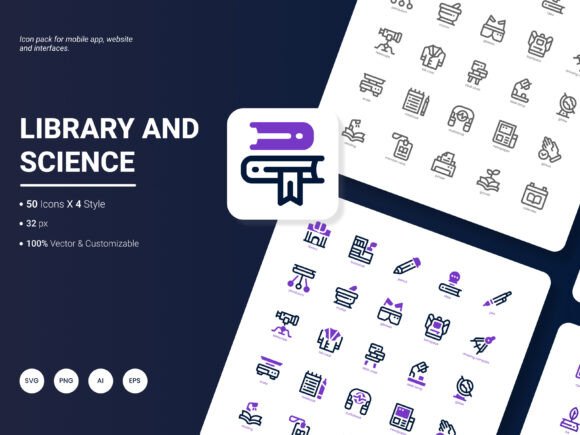
As a designer who spends more time staring at stitch simulations than most people care to admit, I approach new design assets with a healthy dose of skepticism. When I first opened the Library and Science Icon Pack, my initial reaction was one of visual appreciation. The collection comprises 200 stylish icons that clearly showcase popular services and ideas related to academia, research, and literature. However, my job isn't just to look at pretty pictures on a screen; it is to determine if these Graphics can survive the transition from a digital vector to a tangible machine embroidery design. This review breaks down how this pack performs when put to the test in real-world embroidery projects.
First Impressions and Visual Personality
The mood of the Library and Science Icon Pack is clean, intellectual, and modern. The shapes are distinct, avoiding unnecessary clutter, which is a promising sign for embroidery. In our trade, less is often more, especially when dealing with small details that can get lost under thread bulk. The layout suggests a versatility that appeals to both educational institutions and boutique brands looking for a scholarly aesthetic.
Visually, these Icons feel like they belong on high-end stationery or tech interfaces. The challenge for us as embroiderers is translating that crisp digital line work into satin stitch, fill stitch, or running stitch without losing the definition. The iconography includes classic symbols like open books, microscopes, beakers, and graduation caps. These are timeless motifs, but their success depends entirely on how well the underlying embroidery file handles stitch density and direction.
Real-World Application: The Custom Tote Bag Scenario
To give you a practical perspective, let's walk through a specific scenario. Imagine a local university alumni association has hired you to create a run of limited-edition merchandise. They want a series of canvas tote bag designs featuring various departments. This is where the Library and Science Icon Pack shines.
I selected a few icons representing the biology and literature departments to test on a heavy-weight cotton canvas. Because canvas has a noticeable fabric texture, fine details can sometimes sink in. However, the bold nature of these icons held up remarkably well. The stitch density appeared balanced enough to provide good coverage without causing the fabric to pucker excessively. For a small shop product or an Etsy seller looking to expand into niche academic gifts, this pack offers a ready-made library of imagery that feels professional rather than clip-art generic.
Beyond tote bags, I could easily see these working as sweatshirt embroidery for study groups or science clubs. Placed on the left chest of a hoodie, a single microscope or book icon acts as a subtle badge of identity. It elevates a standard garment into a piece of custom apparel that students actually want to wear. The simplicity of the designs ensures they remain legible even from a distance, which is crucial for brand recognition.
Navigating Technical Challenges
While the Library and Science Icon Pack is robust, it is not without its constraints. As with any collection of 200 items, consistency can vary. When working with smaller hoop sizes, such as those found on cap frames or baby bibs, you must be vigilant. Some of the more intricate science instruments might have tiny corners or thin lines that could break or become indistinct if scaled down too far.
If you are planning to use these on stretchy fabrics like jersey knits for baby embroidery, the choice of stabilizer becomes critical. A cut-away stabilizer is likely necessary to prevent the design from distorting after multiple washes. Similarly, if you are attempting these on dark fabrics, you need to verify the thread colors included in the file. If the original digitizing assumed a light background, you may need to manually adjust the underlay or add a backing layer to prevent the fabric color from showing through the stitches.
Curved surfaces, like baseball caps, present another hurdle. An icon that looks flat on a screen might twist awkwardly over the curve of a cap front panel. I recommend testing a few of these on scrap fabric mounted in a cap frame before committing to a full production run. Pay close attention to the edges of the icons; if they rely heavily on long satin runs without proper tacking, they might snag during wear.
Enhancing Product Value and Brand Consistency
For craft business owners, the value of a design pack lies in its ability to streamline production while maintaining high quality. The Library and Science Icon Pack allows for rapid prototyping of new products. Whether you are creating holiday embroidery gifts for teachers or designing a line of embroidered patches for a science museum gift shop, having a cohesive set of 200 icons saves hours of sourcing individual images.
This consistency builds trust. When a customer sees a matching set of icons on a series of products—say, a notebook cover, a pencil case, and a mug cozy—they perceive a higher level of professionalism. It signals that the handmade product was thoughtfully curated rather than hastily assembled. For commercial embroidery projects, this kind of visual cohesion is essential for client satisfaction and repeat business.
Furthermore, these designs work exceptionally well for printable mockups. Before you even thread your machine, you can place these graphics into your digital previews to show clients exactly what the finished product will look like. This helps manage expectations and speeds up the approval process.
Practical Notes for the Studio
Before you dive into using the Library and Science Icon Pack for paid orders, here are a few essential steps I always take:
- Test on Scrap Fabric: Always stitch out a sample on the exact material you intend to use for the final item. This reveals issues with tension and density immediately.
- Check Licensing: Since this pack is marketed for website and presentation use, verify the license terms regarding commercial embroidery. Ensure you have the right to sell physical items made with these designs.
- Inspect Small Details: Zoom in on the digitized file. Look for potential jump stitches that are too long or areas where the stitch direction might cause shading issues.
- Contrast Testing: Run a black-and-white simulation to ensure the design holds its shape without relying on color contrast alone.
- File Format Verification: The product description mentions it is perfect for digital use, but confirm that the package includes the specific digital embroidery file formats compatible with your machine (e.g., PES, DST, EXP).
In conclusion, the Library and Science Icon Pack is a versatile resource that, with careful preparation, can yield stunning results. It bridges the gap between digital utility and tactile craft. While it requires a discerning eye to adapt certain elements for difficult fabrics or small hoops, the core designs are strong, recognizable, and highly marketable. For the creative entrepreneur willing to do the necessary testing, this pack offers a solid foundation for a wide range of personalized gifts and boutique merchandise.